While My Journey told the story of my progress throughout the semester, this page describes the Student Learning Outcomes and how well I’ve been able to reach them as the semester has passed. Some of them I’ve got a strong grasp on, and others I’m still learning, but regardless, here they are.

Writing Processes & Adaptation
“Students will be able to describe and reflect on writing processes in order to flexibly adapt them to support their goals.”
Multiple Literacies & Goal Setting
“Students will be able to demonstrate how they marshal/leverage their multiple literacies (e.g. speaking, listening, reading, multilingual writing, translating, multimodality, etc.) to support their writing processes.”
Variation Across Contexts
“Students will be able to identify, analyze, and reflect on variation in rhetorical and linguistic patterns, including their own, from a range of contexts (e.g cultural, digital, workplace, and/or academic).”
Decision Making & Production
“Students will be able to produce writing that demonstrates their ability to navigate choices and constraints when writing for specific audiences, genres, and purposes.”
Writing and Power
“Students will be able to critically examine and act on the relationship among identity, literacy, language, and power.”
Revision
“Students will be able negotiate differences in and act with intention on feedback from readers when drafting, revising, and editing their writing.”
Writing Processes & Adaptation
“Students will be able to describe and reflect on writing processes in order to flexibly adapt them to support their goals.”
Throughout this course, I’ve had to keep a keen eye on my own writing processes to be able to adapt them to reach the goals required by assignments. I feel my initial ability to reflect on my own writing process can be seen through the Unit 3 Essay and its revision, although I admittedly don’t completely reflect on how my process works in those works. My actual ability is better shown firstly in Reading Response 7, as shown below, when I reflected on how much freedom I enjoyed while writing. It’s also shown in the Unit Two Project, where I finally understand how my writing process works and where I went wrong in my previous reflections. My ability to adapt my process is best shown through the Unit Four Paper, where I’m able to adapt my distracted and disorganized process to make an academic paper by using structure ahead of time.

Multiple Literacies & Goal Setting
“Students will be able to demonstrate how they marshal/leverage their multiple literacies (e.g. speaking, listening, reading, multilingual writing, translating, multimodality, etc.) to support their writing processes.”
The Unit 5 Project, pictured below, show me translating my academic essay into a different mode. Had I turned it into a speech, it would’ve showed my literacy in speaking as well, but either way, I was able to use my knowledge of both academic essays and letters to express my knowledge of multi-modal forms of expression, though not to the best of my ability. My multiple literacies helped me, but I don’t believe I demonstrated it as much as I could’ve, as I could’ve used more of my literacies or better shown how they support my writing process. Regardless, I believe I’m able to fulfill this learning outcome.


Variation Across Contexts
“Students will be able to identify, analyze, and reflect on variation in rhetorical and linguistic patterns, including their own, from a range of contexts (e.g cultural, digital, workplace, and/or academic).”
I believe that my ability to find differences between patterns across contexts is best shown in the Unit Four Paper, where I display my ability to reflect on a common writing construct from an academic context. This is supported by the Unit Five Project showing me adapt that same argument to a more personal context. I change my rhetorical and linguistic patterns from a more rigid, controlled, and academic type of writing to a more personal and relaxed prose, and I believe it demonstrates my ability to fulfill this learning outcome. It’s hard to change the way you write and speak if you don’t understand the differences in contexts, after all.
Decision Making & Production
“Students will be able to produce writing that demonstrates their ability to navigate choices and constraints when writing for specific audiences, genres, and purposes.”
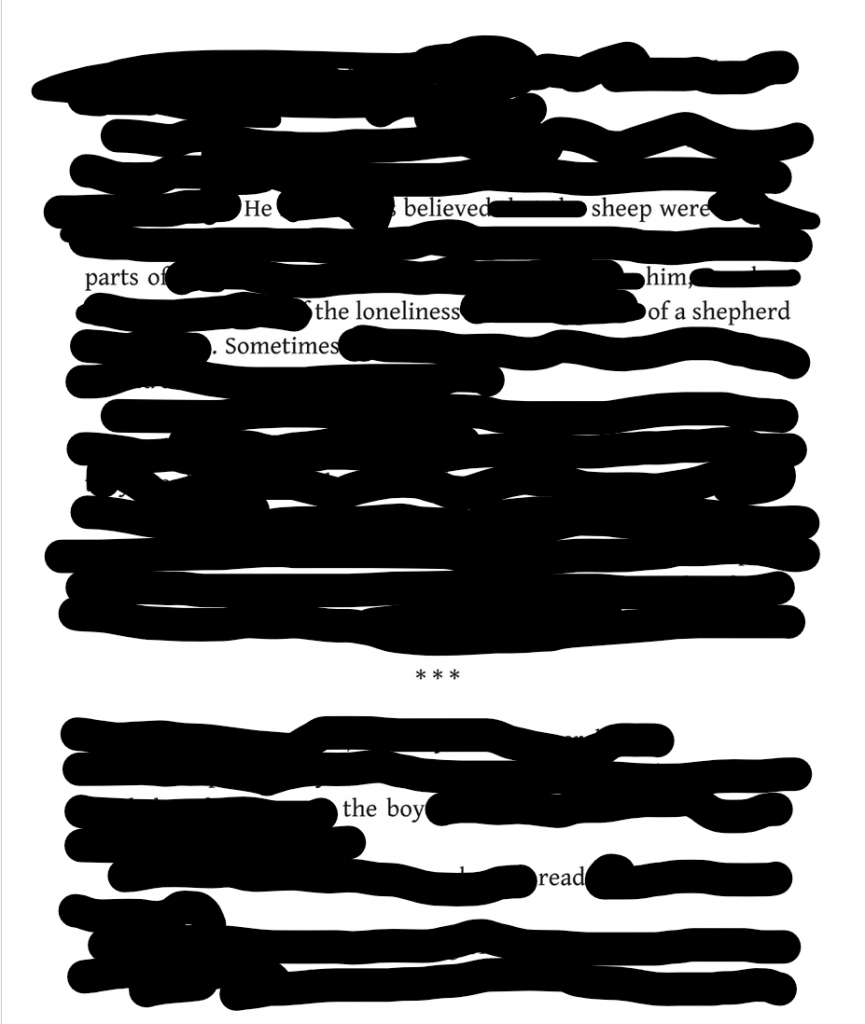
My favorite example to show that I’ve learned to navigate choices and constraints is Creative Writing Response 5 shown below, as it shows how I use the genre of blackout poetry to create what I felt was an interesting story. I enjoyed seeing how such constraints led to me carefully choosing each word that went into the story, and how succinct it felt as a result. Other examples to show my ability to make such choices for specific audiences or purposes would be the Unit Four Paper and Unit Five Project, where I make specific decisions on how I write and who it’s meant for. Overall, I feel I’ve learned this outcome well.
Writing and Power
“Students will be able to critically examine and act on the relationship among identity, literacy, language, and power.”
In the Unit 4 Paper, I briefly touch upon how identity and literacy interact in the argument that academic essays can be personal, as the identity of the author can benefit their works, but I don’t feel I was able to completely examine the relationship, due to the nature of the paper being to argue against a construct. However, I believe that I was able to better examine the relationship in Creative Writing Response 3, when analyzing “Sing a Song of Sixpence.” In the assignment, I was able to see how the poem was able to portray powerful themes in such simple language, and how such a seemingly innocuous nursery rhyme could be interpreted in such revolutionary ways. It reminds me of the old adage, “The pen is mightier than the sword.”
Revision
“Students will be able negotiate differences in and act with intention on feedback from readers when drafting, revising, and editing their writing.”
Throughout this course, I’ve learned the ability to revise my work by taking in feedback and making decisions to change my writing. The first example was with my Revised Unit 3 Essay, which showed me failing to completely take in and understand feedback, but still making revisions to better my work. Next was the difference between the Unit 5 Rough Draft and the finished work, which showed a failure on my part to accurately take in feedback, as I didn’t end up taking advice that would’ve helped me put out a better project. This mistake helped me realize just how important feedback and revision is in writing. Lastly, for the Unit 2 Project I asked friends to help me out with it, giving feedback and advice, and I made sure to incorporate it to properly revise my work until I was satisfied with how it turned out.
Final Reflection
Ultimately, I feel I’ve done a good job at achieving the learning outcomes for this course. I’ve made plenty of mistakes and slip-ups throughout the year, but growing past those mistakes and learning more about writing has been extremely fulfilling and enjoyable. I can look back and see just how far I’ve come, I see the progress and it fills me with hope that I’ll be able to continue on this path of learning. Although I feel I’ve achieved these learning outcomes relatively well, I’m sure that in the future I’ll grow even more and become even stronger with these concepts, that I’ll have even more artifacts that demonstrate my proficiency with such outcomes. I have high hopes that I have much to learn, and I can thank this course for preparing me for that path ahead.