The Beginning
Early on this semester, I wasn’t nearly as aware of my own writing process as I liked to pretend I was. I was able to understand the literal process of me writing, but I didn’t often actually think about the way I took the words and ideas I was trying to express and put them to paper. This is best demonstrated by the original Unit 3 Essay. I was able to see the rituals and situation I needed to write, but not the process of thinking itself. Despite being all about my train of thought, all I could capture was what outside scenarios I needed for it to move, not what the train of thought itself was like. An especially egregious example is displayed to the right.

Below are some apt criticisms I received on this section, which helped me realize just how off-track I went:
- “Very wordy sentences”
- “Too much. Stop! Your food intake shouldn’t be given its own paragraph, should it?”
I got so caught up in my own descriptions that I forgot to stop and think about what I was adding to the paper, I didn’t notice how off-track I got.
Getting Warmer Now
Seeing the feedback on my paper, my first thought was to dismiss it, since I threw it together last-minute anyways. But as I thought more and more about the comments and mistakes, I realized that they revealed problems that went further than writing last minute and not proof-reading well enough. I saw problems like how I would get off-track, how I’d write too abstract, and how I’d go on tangents over minor details. I didn’t quite piece together the puzzle and see the bigger problem, but I made a revision that attempted to address some of the problems with my first paper.

Taking Steps
Even if it wasn’t perfect, I was taking steps to make my paper better, to work on the mistakes I made.
Setting Up
I didn’t understand the core problems causing the mistakes I was making, but this experience set me up to later realize while working on a completely different assignment.

“Do, or do not. There is no try.”
– Yoda, Jedi (Former) Grand Master
Ups Before Downs
In the Unit Four Paper, I was able take a good look at my writing process and finally started changing it to fit the situation. I structured it, reviewed it after, and felt proud when I turned it in and got a good score. There were of course errors; I wasn’t completely familiar with MLA, so I misused citations a couple of times, and the conclusion was a bit sloppy. However, I kept myself on track and understood how to change my writing process to better conform to the academic context, and I’m proud of myself for that. Even if I wasn’t actively thinking about it, I had better knowledge and control over my writing process, and it helped me improve.
Things Start Clicking
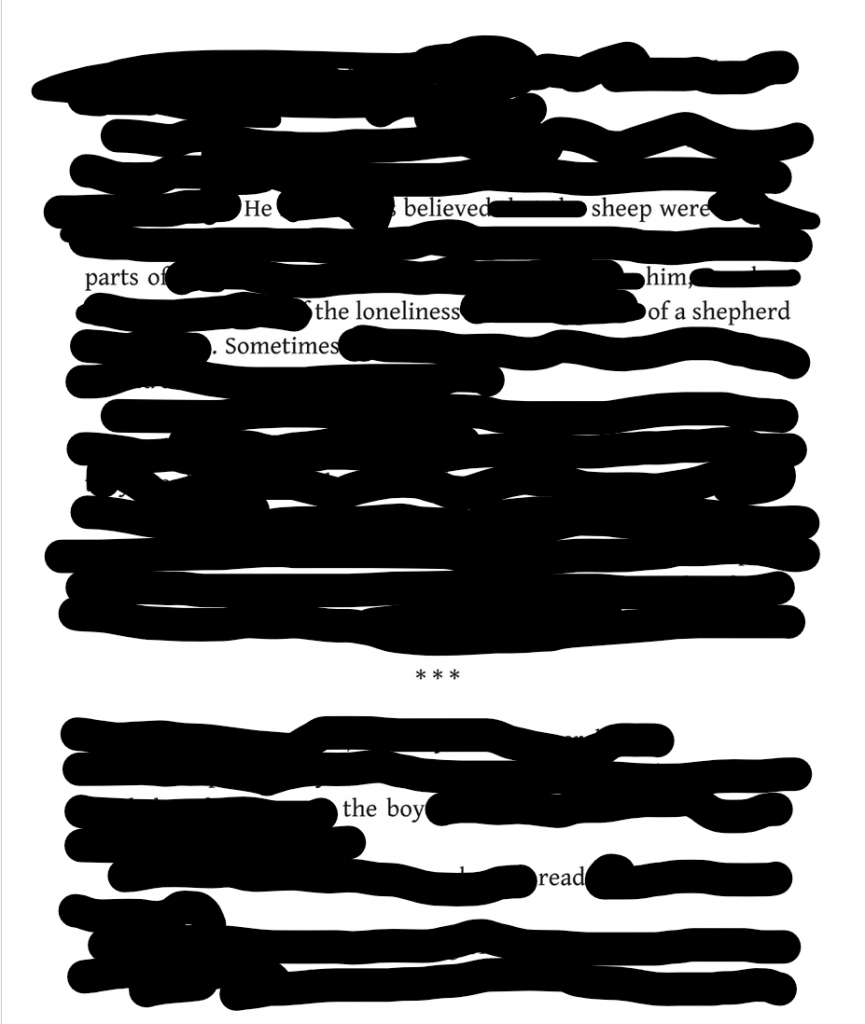
During Reading Response 7 and Creative Writing Response 5, as pictured to the right, my knowledge of my writing style started clicking into place, even if I didn’t realize it. For the Reading Response, I could introspect and write about how much freedom I enjoyed while writing. For the Creative Writing Response, I was able to use my distracted and abstract writing process to my advantage, picking up words from one of my favorite books, The Alchemist by Paulo Coelho, and stitching them together to tell a short, sweet little story. I finally found my nook where I was able to naturally shine. These assignments, although simple, allowed me to think about how I write from a new perspective. I could think of so many questions, like “How does the amount of rules and restrictions affect my writing style? How does it affect my work?” and “How is choosing a specific word I see and blacking out the ones I don’t want different from the way I already write? How is it similar?” Answering those questions for myself really helped me see into my writing process quite a bit better than I had before.


You Win Some, You Lose Some
After my previous successes, I got overconfident. I stopped thinking about my writing process, and my lack of good self-awareness made me stubborn, refusing to stray from the idea of adapting the academic paper to a personal letter. I was so enveloped in the idea of a letter in an envelope that even when I got good feedback, asking why it had to be a personal letter, and why not a recorded speech, I ignored it to stay on track with my personal vision. The result was a rushed, mediocre letter, but it could’ve been better had I listened to feedback and changed what I adapted it to, or changed how I worked in the confines of a letter. After it was graded and I realized how much I let myself down, I knew I didn’t want to make the same mistake again.
Onward and Upwards
As I was making up the Unit Two Project, a lot of the thoughts I had on my writing process started finally coming together. I could finally understand the specific issues I was being plagued by, I could finally see how my writing process worked, and how it both helped and hurt my work. By analyzing my works and what their strengths and weaknesses were, and internalizing the feedback I got on them, I realized more than ever how me being an impulsive writer affects my works. I got a close look at the fact that my style is only hurt by my tendency to procrastinate, and saw how my lack of structuring or solid review were hindering me. It stung to see my issues on the front page, but it felt good to finally wake up to the fact that I could change, that I can write in my style but also take precautions to minimize the issues I suffer with structure and distraction.

- While writing the paragraph above, the whole picture really started coming together for me, seeing just how much procrastination hurts me
- It was frustrating seeing how I didn’t see the problems before, how distracted I got, but I’m filled with hope that I’ll be able to apply what I’ve learned in the future

And Here We Are Now
And now, here we are! See, this very ePortfolio is a part of my journey as well, it’s a reflection of all of my work over the past semester. I’m not just viewing one cycle of my writing process in practice, I’m viewing all of them, and that’s helped give me so much context and understanding over my journey. It’s let me see just how far I’ve come, it’s let me see when I was getting stronger and when my shortcomings got the best of me, and it’s let me see the path forward, like a lighthouse guiding the way forward. I still have much more to grow, but this ePortfolio has allowed me to see just how far I’ve come.